
How I Study the Bible: Explore, Examine and Extend

Updated: Sep 27
The Word
“But He answered and said, ‘It is written, “Man shall not live by bread alone, but by every word that proceeds from the mouth of God."'" Matthew 4:4 [NKJV]
The Word of God is precious to us as believers. Just as our bodies need physical food, our souls need the nourishment that comes from God's Word. This is why I believe Bible study should become a daily habit—not simply something we do when we have extra time.
There are many Bible study methods available, but over the years I have developed a simple approach that has deeply impacted my own walk with God.
I call it:
Explore. Examine. Extend.
This method can be used whether you are a beginner opening the Bible for the first time or someone who has been studying Scripture for many years.
But before I explain the method, let me share why Bible study became so meaningful to me.
-----------------------------------------------------------------
My Personal Journey With Bible Study
Before I committed my life completely to God, I worked full-time in IT. It was largely a desk job, with limited interaction with other people.
I would put on my headphones, listen to worship music, and get on with my work.
Looking back, I realise how much that time of worship was preparing my heart.
Worship helped me quiet the unnecessary worries and concerns that could easily fill my mind. By the time I opened my Bible in the evening, I was in a different frame of mind. I was ready to listen.
And then something beautiful began to happen.
The words of Scripture seemed to become so loud and clear. They would go straight into my heart, bringing conviction, encouragement and understanding.
Scripture became intriguing to me.
It was almost like popcorn—the words would begin to jump off the pages and become real and present. A verse I may have read many times before would suddenly stand out in a completely different way.
One verse would lead me to another. One thought would make me want to understand something deeper.
It felt as though I was being drawn into an ocean of God's Word, discovering pearls I had never noticed before.
And as I discovered those pearls, my faith began to grow.
I like to picture it as a thread being passed through each pearl, gradually forming a necklace. In the same way, Scripture becomes familiar to us when we continually read, meditate on and apply it. Eventually, God's Word stays with us—not only on the pages of our Bible, but in our hearts and minds.
There were nights when I would go to sleep thinking about a particular verse, meditating on it and turning it over in my mind.
That is when Bible study became more than simply reading words.
It became an encounter.
When Scripture Comes Alive
As a Christian, I believe the Holy Spirit helps us understand and respond to God's Word. He can bring a particular Scripture to our attention and help us see how it speaks into our circumstances.
In my experience, this is what many Christians describe as revelation—a moment when a passage that we may have read many times suddenly becomes deeply meaningful.
There is an eye-opening moment when Scripture seems to jump off the page.
Suddenly, a familiar verse takes on new depth.
There is a connection between the Word of God and our present circumstances, and we begin to understand something we may not have noticed before.
The Greek word rhema is often used in Christian teaching when discussing a spoken or specifically applied word. Different Christian traditions explain the distinction between logos and rhema in different ways, but for me, the important part is the experience of Scripture becoming personally meaningful and calling me to respond.
This experience encouraged me to dig deeper.
And over time, God opened the door for me to teach others what I was learning.
That brings me to the simple Bible study method I use today.
-----------------------------------------------------------------
Explore, Examine and Extend
My approach has three stages:
Explore — understand the big picture.
Examine — study the details.
Extend — apply God's Word to your life.
Let's look at each one.
Step 1: Explore the Passage
The first thing I do is choose the passage or chapter I want to study.
At this stage, I am looking at Scripture from a bird's-eye view.
The goal is to understand the bigger picture before getting caught up in individual verses.
Who wrote the book?
Start by asking:
Who is the author?
Who was the original audience?
Why was the book written?
What type of book is it?
Is it a historical account, a letter, prophecy, poetry, wisdom literature or something else?
Understanding the author and purpose of a biblical book can help us appreciate the passage within its original setting.
It can also help us understand the timeline, location and circumstances surrounding the text.
Sometimes I will also explore details about the author's background, occupation and experiences because these can provide additional context.
If you have studied the Bible for many years, you may already know much of this information. In that case, you can move more quickly through this step.
What is happening around the passage?
Next, I look at the context.
Ask:
What happened before this passage?
And:
What happens immediately afterwards?
A verse should not normally be studied in isolation from the surrounding passage. The verses before and after it can help us understand what the writer is communicating.
I also consider the historical, cultural, political, and geographical background when relevant.
For example, many biblical customs and practices are unfamiliar to modern readers. Festivals, feasts, cultural traditions and social expectations can all influence how we understand a passage.
The discussion about head coverings in 1 Corinthians 11:4–16 is one example where cultural and historical context can become important.
Geography can also help.
For example, Acts 21:12 describes Paul travelling to Jerusalem from Caesarea. Looking at a biblical map can help us understand the geographical setting and why the language of travelling “up” to Jerusalem can initially seem confusing to a modern reader.
You don't need to become a biblical historian before you can study Scripture.
If you are a beginner or have limited time, you can keep this step simple.
The goal is simply to understand the big picture.
Step 2: Examine the Details
Once I understand the larger context, I move closer.
This is the worm's-eye view.
Now I want to examine the passage carefully and identify its main message.
I ask questions such as:
What is the main theme of the passage?
What is happening?
When did it happen?
Where did it happen?
Who are the key people?
What did they do?
How did the events unfold?
Why did they respond the way they did?
What is the writer trying to communicate?
What does this passage reveal about God?
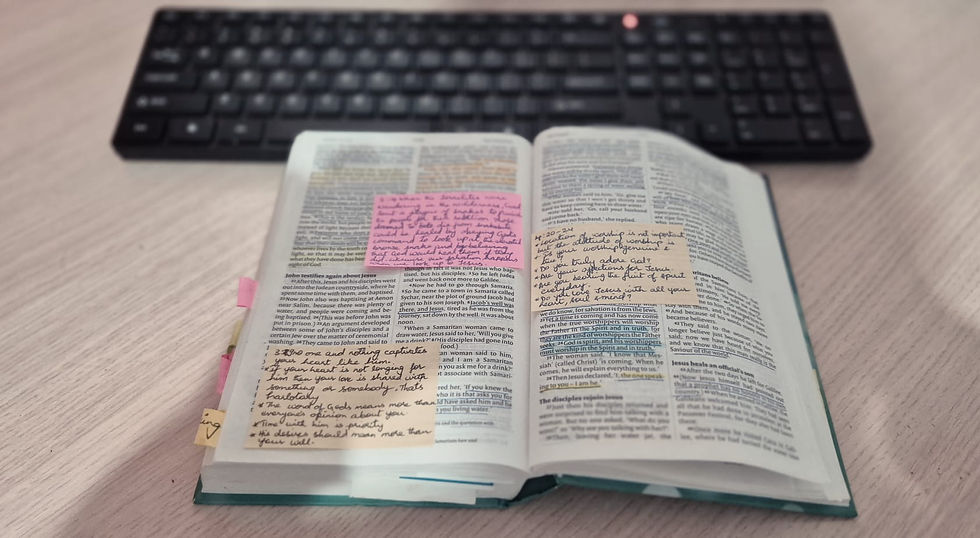
This is also the stage where I underline, highlight or make notes about words and phrases that stand out to me.
Sometimes one word can cause me to pause and investigate further.
Other times, a repeated phrase, a command, a promise or a change in the story will catch my attention.
Don't be afraid to slow down.
Bible study isn't a race to finish a chapter.
Sometimes one verse deserves more attention than an entire chapter.
Look for the Main Argument
As you examine the passage, try to identify the central idea.
Ask:
If I had to explain this passage in one or two sentences, what would I say?
This simple question can help prevent us from getting lost in small details while missing the main point.
Once you understand the central message, you can then explore the details that support it.
Step 3: Extend It to Your Life
This is where Bible study becomes personal.
I call this stage Extend because we take what we have learned from Scripture and consider how it should affect our lives today.
Paul writes:
“All Scripture is God-breathed and is useful for teaching, rebuking, correcting and training in righteousness.”
2 Timothy 3:16 [NIV]
So I ask questions such as:
What is the key takeaway from this passage?
Is there something God is asking me to change?
How can I become more like Christ?
How can I draw closer to Jesus?
Is there an attitude I need to surrender?
Is there something I need to obey?
How can this passage help me persevere through trials?
Is there a promise here that I need to remember?
Is there an instruction I need to follow?
How can I positively influence my family or Christian community?
How should this Scripture change the way I think, speak or behave?
This is where we move from information to transformation.
Bible study isn't simply about knowing more Bible verses.
It is about allowing God's Word to shape our hearts, our character and our daily lives.
The Four Questions I Keep Coming Back To
In simple terms, I want my Bible study to help me understand:
What- What does the passage say?
Where- Where did it happen, and what is its context?
When- When did it happen, and what was happening at that time?
How- How did it happen, and how should I respond today?
When these questions are answered, Scripture begins to move from something we simply read into something we understand and live.
-----------------------------------------------------------------
How I Use Different Bible Translations
I usually read the NIV, NKJV and NLT when studying Scripture.
I also sometimes use Strong's Concordance to explore the underlying Hebrew or Greek words when I need additional clarity.
Because I teach the Bible, I find this particularly helpful. The Old Testament was primarily written in Hebrew, with portions in Aramaic, while the New Testament was written in Greek.
Translation is not always straightforward. A single word in the original language can sometimes carry a range of meaning that is difficult to communicate through one English word.
Different Bible translations can therefore help us notice different aspects of a passage.
However, you don't need multiple translations, commentaries or study tools to begin studying the Bible.
If you are a beginner, don't let the number of resources overwhelm you.
Start with the Bible you have.
Open it.
Read it.
Ask questions.
Pray.
And allow yourself time to understand what you are reading.
The Explore, Examine and Extend method is enough to give you a strong foundation.
Don't Rush Your Bible Study
One of the biggest lessons I have learned is this:
Don't rush through Scripture simply to say that you finished a chapter.
The goal isn't to complete a reading plan as quickly as possible.
The goal is to know God and allow His Word to shape you.
Sometimes you may read an entire chapter and nothing particular seems to stand out.
Other times, you may spend thirty minutes on a single verse.
Both are okay.
Give yourself permission to slow down.
Wait.
Reflect.
Ask questions.
Pray.
Let Scripture sink into your heart.
I believe the Holy Spirit can create within us a desire to dig deeper as we take the simple first step of opening our Bible and reading.
Meditate on God's Word
Bible study doesn't end when we close our Bible.
Meditation is an important part of allowing God's Word to remain with us.
Joshua 1:8 says:
“Keep this Book of the Law always on your lips; meditate on it day and night, so that you may be careful to do everything written in it.”
Joshua 1:8 [NIV]
For me, biblical meditation means continually returning to God's Word—thinking about it, remembering it, praying about it and allowing it to influence how I live.
The Word becomes part of our thinking.
A verse we studied in the morning can come back to us during the day.
A promise can encourage us when we are struggling.
An instruction can challenge us when we are making a decision.
A passage can remind us of God's character when circumstances make us afraid.
That is when Scripture becomes more than something we read.
It becomes something we live.
-----------------------------------------------------------------
Final Thoughts: Go Deeper Into God's Word
My prayer is that Bible study would never become just another item on our daily checklist.
The goal is not simply to finish the passage.
The goal is to encounter God through His Word, understand what Scripture teaches, allow the Holy Spirit to work in our hearts, and respond in obedience.
God's Word has depth.
There are treasures waiting to be discovered.
So don't be discouraged if you don't understand everything immediately.
Start where you are.
· Open your Bible.
· Explore the context.
· Examine the details.
· Extend the truth into your life.
· Then meditate on what you have learned.
Explore. Examine. Extend.
That simple pattern has helped me go deeper into God's Word, and my prayer is that it will help you, too.
May God's Word become increasingly alive in your heart, strengthen your faith, draw you closer to Jesus, and transform the way you live each day.
Don't just read the Word. Let the Word take root in you.
Comments