
Parable of the Ten Virgins — Be ready

Updated: 5 days ago
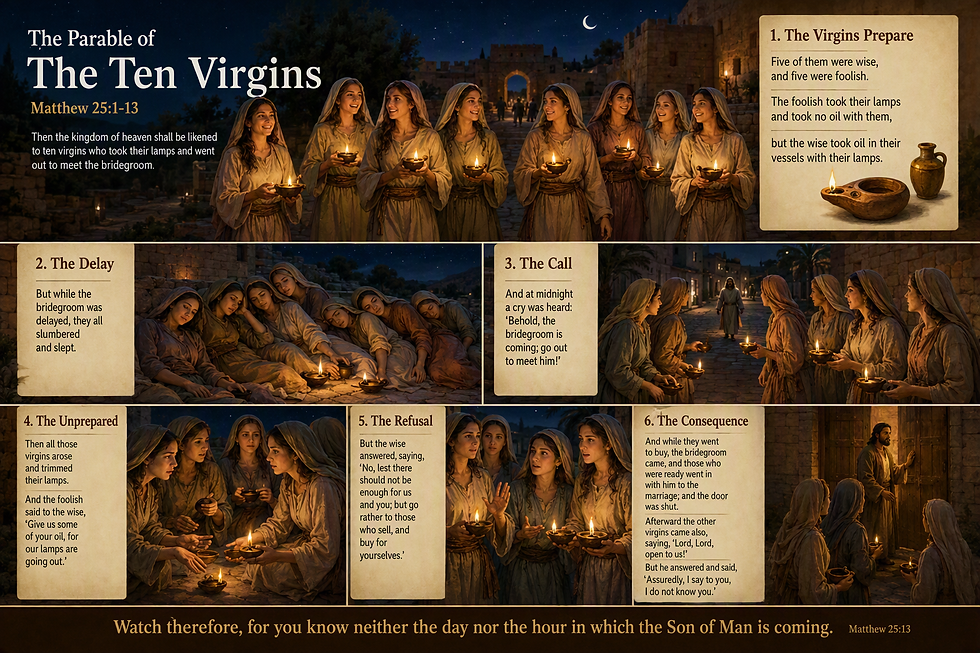
Read aloud: Matthew 25:1–13
Key thought: Are you ready for the Bridegroom?
Introduction: Why Did Jesus Speak in Parables?
Jesus often spoke in parables for a reason. A parable invites us to look beyond the surface of a story and discover the deeper truth and wisdom that God is imparting.
The Word of God is for willing hearts—hearts that are prepared to listen, receive, understand, and obey. It is possible to hear the Word of God without truly perceiving what He is saying.
Mark 4:9–12 [NIV]
Then Jesus said, “Whoever has ears to hear, let them hear.”
When he was alone, the Twelve and the others around him asked him about the parables. He told them, “The secret of the kingdom of God has been given to you. But to those on the outside everything is said in parables so that,
“ ‘they may be ever seeing but never perceiving,and ever hearing but never understanding;otherwise they might turn and be forgiven!’ ”
Jesus is therefore asking us not merely to hear the parable, but to allow its message to examine our hearts.
As we study the ten virgins, the question is not simply, “Who are the foolish virgins?” The question is, “Am I ready?”
-----------------------------------------------------------------
Step 1 — Explore the Passage
Before we examine the details, let us first understand the bigger picture.
Tell the Story in Your Own Words: Summary
The parable is about ten virgins. Five were foolish, and five were wise. They went out to meet the bridegroom. The foolish virgins took their lamps but did not take any oil with them. The wise virgins, however, took oil along with their lamps.
There was a delay in the bridegroom's arrival. At midnight, a cry went out:
“The bridegroom is coming! Come out to meet him!”
All ten virgins woke up and trimmed their wicks. The foolish virgins realised that their lamps were going out, so they asked the wise virgins to give them some of their oil. The wise virgins explained that they did not have enough oil for everyone and told them to go and buy some for themselves. While the foolish virgins were away buying oil, the bridegroom arrived. The virgins who were ready went in with him to the wedding banquet, and the door was shut.
Later, the other virgins returned and called out, asking for the door to be opened. But it was too late.
Jesus concludes: “Therefore keep watch, because you do not know the day or the hour.” Matthew 25:13
Keywords: Wedding, Bridegroom, Bridesmaids, Oil
-----------------------------------------------------------------
Let us use the Explore, Examine, and Extend approach. Take your time to find answers to the questions in each section. It would be a good exercise to think and reflect on your own.
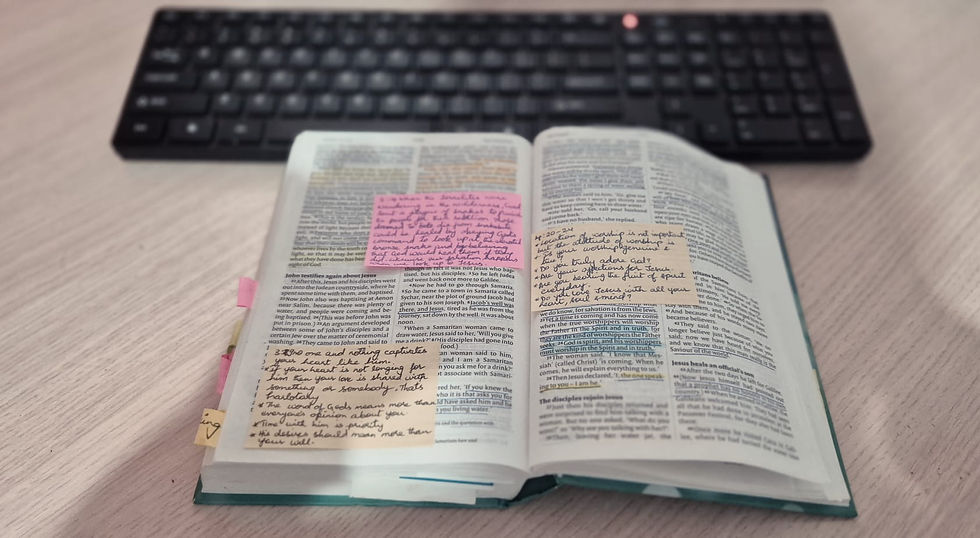
Note: The answers are at the top of the post, directly below the image as an attachment.
Step 1: Explore the Passage
Ask:
Who is the author?
Who was the original audience?
Why was the book written?
What type of book is it?
Historical account?
Letter?
Prophecy?
Poetry?
Wisdom literature?
Something else?
What cultural traditions would the original audience have understood that we may not immediately understand today?
-----------------------------------------------------------------
The Wedding Tradition
One important tradition to understand is betrothal.
Many people in the West today may not be familiar with the ancient Jewish wedding process, but the original audience would have understood the significance of betrothal. Betrothal went beyond what we would normally think of as an engagement today. It represented a binding commitment and agreement between the bride and groom, signifying their commitment to a lifelong relationship and their promise to be faithful to one another.
The bridegroom would bring gifts and pay a price associated with the betrothal. The couple were legally committed to one another, even though the wedding ceremony had not yet taken place. The bridegroom would then leave to prepare a place for the couple to live. After a period of time, often around a year, the bridegroom would return. There would then be a grand wedding celebration and banquet.
This background helps us understand why Jesus used wedding imagery when teaching about His return.
Joseph and Mary
We see an example of betrothal in Matthew 1:18–24.
Joseph discovered that Mary was pregnant. Because he was a righteous man and did not want to expose Mary to public disgrace, he initially planned to divorce her quietly. This is significant because they were betrothed but had not yet come together as husband and wife.
However, after an angel appeared to Joseph in a dream and explained what had happened, Joseph obeyed God and accepted Mary as his wife. The wedding process, therefore, helps us understand the imagery Jesus uses throughout Scripture concerning Himself, His people, and His return.
-----------------------------------------------------------------
Step 2 — Examine the Details
Now, let us examine what Jesus is communicating through the parable.
Ask:
What is the main theme of the passage?
What is happening?
When did it happen?
Where did it happen?
Who are the key people?
What did they do?
How did the events unfold?
Why did they respond the way they did?
What is Jesus trying to communicate?
What does this passage reveal about God?
What does it reveal about us?
----------------------------------------------------------------
Jesus the Bridegroom
The wedding imagery throughout Scripture gives us a powerful picture of our relationship with Christ.
Jesus is the Bridegroom, and the Church is His bride.
Betrothal can help us understand the commitment involved in our relationship with Christ.
We enter into a relationship with Jesus, and the price has been paid—not by us, but by Christ Himself. The bride price is represented by the sacrifice of Jesus Christ and the blood He shed on the cross.
Jesus secured us through His blood because He loves us.
This is why the return of Christ should not simply be a theological subject to study. It should affect the way we live.
If we are believers, we are waiting for the return of our Bridegroom.
Jesus Is Preparing a Place
Jesus uses wedding language again in John 14.
John 14:2–3 [KJV]
“In my Father's house are many mansions: if it were not so, I would have told you. I go to prepare a place for you. And if I go and prepare a place for you, I will come again, and receive you unto myself; that where I am, there ye may be also.”
Jesus says:
“I go to prepare a place for you.”
This language fits beautifully with the picture of the bridegroom leaving to prepare a place and then returning for his bride.
Jesus promises:
“I will come again.”
Therefore, every believer should live with an expectation of Christ's return so we may be raptured.
-----------------------------------------------------------------
What Is the Rapture?
The rapture refers to the catching away of believers to meet the Lord.
Matthew 24:30–31 [NIV]
“Then will appear the sign of the Son of Man in heaven. And then all the peoples of the earth will mourn when they see the Son of Man coming on the clouds of heaven, with power and great glory. And he will send his angels with a loud trumpet call, and they will gather his elect from the four winds, from one end of the heavens to the other.”
1 Thessalonians 4:16–17 [NKJV]
“For the Lord Himself will descend from heaven with a shout, with the voice of an archangel, and with the trumpet of God. And the dead in Christ will rise first. Then we who are alive and remain shall be caught up together with them in the clouds to meet the Lord in the air. And thus we shall always be with the Lord.”
The picture is one of Christ returning, the trumpet sounding, the dead in Christ being raised, and believers being caught up to meet the Lord.
This makes the message of Matthew 25 especially important: Be ready.
-----------------------------------------------------------------
The Oil: A Picture of the Holy Spirit
In this study, we understand the oil to symbolise the Holy Spirit.
Throughout the Old Testament, olive oil was used in the anointing of kings and in other acts of consecration. For the believer, the indwelling presence of the Holy Spirit and the overflowing presence and power of the Holy Spirit are essential to our walk with God.
The important lesson is that we cannot simply possess the appearance of readiness. We need the reality of a relationship with God.
-----------------------------------------------------------------
The Foolish Virgins
The most challenging part of the parable is that the foolish virgins were not outsiders who had never heard about the bridegroom.
They were waiting for him. They had lamps. They were part of the wedding party. They were excited about the bridegroom's coming. Yet they were not prepared.
This should cause us to examine our own hearts.
-----------------------------------------------------------------
1. They Had Lamps but No Oil
Matthew 25:7
All ten virgins trimmed their wicks, but the foolish virgins lacked oil.
This can remind us of people who become excited about church, programs, worship, conferences, and activities but lack the fruit of the Spirit and a genuine relationship with Jesus. They may love the church, the bride, but not truly know the Bridegroom.
There is a danger in becoming excited about the things surrounding Christianity while neglecting our personal relationship with Christ.
We can be around the things of God without truly walking with God.
-----------------------------------------------------------------
2. Their Commitment Was Tested by Delay
The bridegroom did not come immediately. There was a delay. This is important because waiting reveals what is really inside us. It is easy to be passionate when everything is exciting. It is easy to sing loudly, attend church regularly, participate in programs, and feel close to God when everything is going well.
But what happens when trials come? Do we still have faith? Do we still pray?
Do we still seek God? Do we still obey His Word?
The foolish virgins wanted the wedding celebration, but they were not prepared for the waiting.
Our relationship with Jesus must survive the delay.
-----------------------------------------------------------------
3. They Preferred Someone Else's Voice Over God's Word
We can also become dependent on our favourite preacher, teacher, or spiritual leader without developing our own knowledge of God's Word. It is wonderful to learn from pastors and teachers, but our relationship with God cannot be based entirely on someone else's preaching.
We need to read Scripture for ourselves. We need to pray for ourselves. We need to seek God for ourselves. We need to develop our own relationship with Jesus.
-----------------------------------------------------------------
4. They Tried to Borrow Oil
The foolish virgins asked the wise virgins for oil. But the wise virgins could not give them enough. This teaches us a powerful spiritual principle:
You cannot borrow somebody else's faith.
You cannot borrow:
Your pastor's relationship with God.
Your spouse's relationship with God.
Your parents' relationship with God.
Your friend's relationship with God.
Your church's relationship with God.
You need your own relationship with Jesus.
The wise virgins could not transfer their preparation to the foolish virgins. When the bridegroom came, each person had to be ready.
-----------------------------------------------------------------
Step 3 — Extend It to Your Life
The final step is to bring the Word from the page into our lives.
Ask Yourself:
What is the key takeaway from this passage?
Is there something God is asking me to change?
How can I become more like Christ?
How can I draw closer to Jesus?
Is there an attitude I need to surrender?
Is there something I need to obey?
How can this passage help me persevere through trials?
Is there a promise here that I need to remember?
Is there an instruction I need to follow?
How should this Scripture change the way I think, speak, or behave?
----------------------------------------------------------------
What Does It Mean to Be Ready?
The parable is therefore connected to the return of Christ. The Bridegroom is Jesus Christ, and the virgins represent those waiting for Him.
Some were ready. Some were not.
The difference was not that they had never heard about the bridegroom. The difference was preparation.
The question is: If Jesus came today, would I be ready?
Being ready is not simply about knowing that Jesus is coming.
Being ready means living in a way that demonstrates that we genuinely belong to Him.
-----------------------------------------------------------------
How Do We Prepare?
1. Remain faithful
Luke 18:8
Jesus asks whether He will find faith on the earth when He comes.
We should examine ourselves:
Am I faithful, or have I become spiritually lazy?
2. Live with eternity in mind
2 Peter 3:10–13
Peter reminds us that this present world is temporary and that we should look forward to God's promise of a new heaven and a new earth.
We should not become so attached to this planet and the things of this world that we lose sight of eternity.
3. Live holy and expectantly
2 Peter 3:11–12, 14
If we know that Christ is coming and that this present world is temporary, how should that knowledge affect our lives?
The return of Christ should motivate us to live holy, godly, and faithful lives.
4. Remember that our Redeemer lives
Job 19:25–27
Job expresses his confidence that his Redeemer lives. Our hope is not based on this present world. Our hope is in Christ.
5. Stay watchful
Luke 12:35–40
Jesus teaches His disciples to be ready and watchful because the Son of Man will come at an hour they do not expect.
Readiness requires watchfulness.
-----------------------------------------------------------------
Who Will Enter the Kingdom?
Matthew 7:21
Jesus gives us another serious warning:
“Not everyone who says to Me, ‘Lord, Lord,’ shall enter the kingdom of heaven, but he who does the will of My Father in heaven.”
This connects strongly with the message of the ten virgins. It is possible to say the right words and still not be living in obedience to God.
It is possible to be around the things of God without truly knowing God.
The question is not simply:
“Do I call Jesus Lord?”
The deeper question is:
“Am I living as someone who truly belongs to Him?”
-----------------------------------------------------------------
When Will Jesus Come?
Mark 13:35
Jesus tells us to watch because we do not know when the master of the house will come.
Matthew 24:36
“But about that day or hour no one knows…” We do not know the exact day or hour.
Therefore, the purpose of prophecy is not to encourage us to calculate a date.
The purpose is to encourage us to be ready. We do not need to know when He is coming in order to know that we should be ready now.
The Wedding Banquet
Finally, study Revelation 19 and the wedding banquet associated with Christ's return. The Bible ultimately gives us a beautiful picture:
The Bridegroom is coming.
The wise virgins understood that preparation could not be postponed until the last moment. They prepared before the cry went out. When the bridegroom came, they were ready to go in. The door was eventually shut.
Now, tell me, are you ready?
Comments